Typical 3-to-5-Year Cycle
Most plaster and pebble-finish pools across Maricopa County fall within this baseline when use and maintenance are moderate.
At Phoenix Expert Pool Service, this question matters because an acid wash removes a thin layer of pool plaster rather than serving as routine cleaning. Most residential pools across the Salt River Valley need one every 3 to 5 years, while heavy use or heavy calcium buildup can shorten that interval. Light-use, well-maintained pools may stretch to 5 to 7 years, so surface condition and water chemistry should guide the decision.
Most plaster and pebble-finish pools across Maricopa County fall within this baseline when use and maintenance are moderate.
Heavy use, summer exposure without a cover, well water, dust, calcium scale, and recurring algae can move a pool toward earlier treatment.
A light bather load, good coverage, weekly chemical service, and routine filter cleaning can help a pool reach the longer end of the schedule.
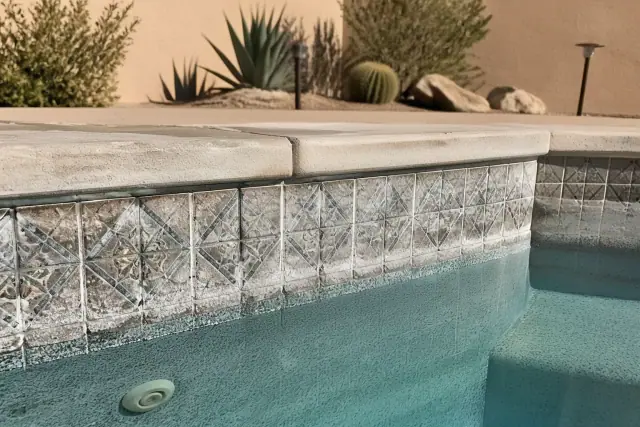
White, crusty deposits at the waterline, on steps, and around return jets. Scale that brushing will not remove can signal the need for deeper surface treatment.
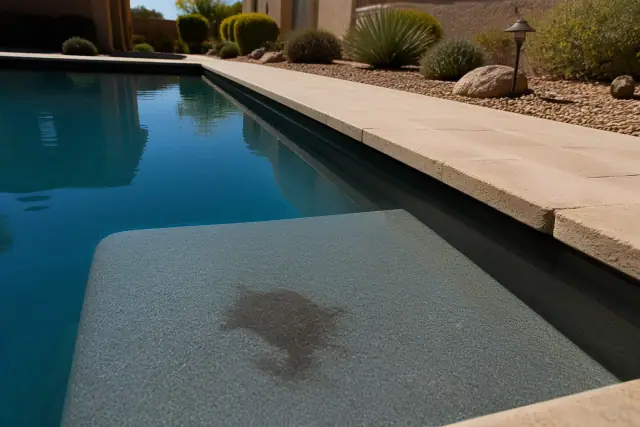
Iron, copper, or organic staining across the pool wall and floor. Embedded discoloration differs from loose residue that a surface cleaner can lift.
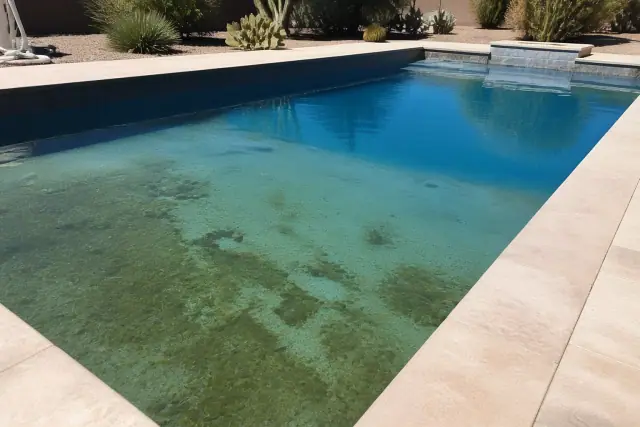
Algae returning in etched or porous areas after normal treatment. The rough finish can shelter spores below the surface chlorine reaches.
Use 3 to 5 years as the standard starting point, then adjust toward 5 to 7 years for light use or toward 2 to 3 years for heavy use and dust exposure.
Watch for tap-water calcium hardness well above 200 ppm, cyanuric acid climbing past roughly 100 ppm, and total dissolved solids crossing roughly 2,500 to 3,000 ppm.
Evaluate the pool when water balance will not hold, cloudiness survives shocking and filtration, algae returns, stains deepen, or chemical costs keep climbing.
Because every acid wash strips a thin plaster layer, the process can only be repeated a limited number of times before resurfacing becomes the better option.
| Pool Situation | Typical Acid-Wash Frequency | Why the Interval Changes |
|---|---|---|
| Standard residential pool with moderate use | Every 3 to 5 years | Baseline mineral and chemical accumulation |
| Light use with a strong maintenance program | Every 5 to 7 years | Lower bather load and consistent chemical service |
| Heavy use or a dust-heavy setting | Every 2 to 3 years | Faster staining and scale formation |
| Neglected or green pool | As needed, outside the schedule | Organic staining can penetrate plaster |
The calendar is a starting point, not a reason to acid wash a healthy surface early. A standard Phoenix-area residential pool with moderate use often fits the 3-to-5-year cycle. Pools that have not been drained in four or more years deserve closer attention when the water feels slick, looks dull, or will not respond to normal chemistry. The current plaster condition, stain depth, and water test results should determine whether an acid wash or resurfacing makes more sense.
Phoenix pool water can remain in the high 80s and 90s for months, while well over 300 sunny days a year increase evaporation, refilling, UV exposure, and chemical top-offs. Calcium and dissolved minerals remain behind as water evaporates, concentrating scale on plaster, tile, and equipment in Phoenix, Scottsdale, Ahwatukee, Arcadia, and Desert Ridge. A cover, light bather load, weekly service, filter cleaning, correct calcium hardness, and cyanuric acid under 50 ppm can help extend the interval toward 7 years.
How much does an acid wash cost? The typical range is $350 to $800 for a standard residential pool and up to $1,500 for a larger or heavily stained surface. Does a green pool follow the normal schedule? No; a neglected or green pool may need treatment as conditions require because organic staining can penetrate plaster. Can routine service prevent every acid wash? Consistent chemistry and filter cleaning can lengthen the interval, but repeated acid washing eventually removes enough plaster that resurfacing becomes the better option.
Share the pool's finish, maintenance history, water-test results, and visible warning signs. A local pool professional can compare the surface condition with the typical Arizona schedule before recommending an acid wash or resurfacing.