Proudly serving Phoenix, Scottsdale, Glendale, Mesa, Tempe, Chandler & surrounding areasCall or Text 24/7: 602-449-8063
Aerial view of a residential neighborhood with Saguaro cacti and stucco homes in Phoenix, AZ under a clear morning sky.

Pool Tile Cleaning & Calcium Scale Removal in Phoenix, AZ

Phoenix Expert Pool Service provides professional pool tile cleaning across Phoenix and the Salt River Valley. We remove calcium scale and restore waterline tile with low-pressure bead blasting, tile-rated pumice, and pH-buffered acid methods selected for the deposit and surface. Our related services include pool acid washing, weekly pool cleaning, green pool cleanup, chemical service, filter cleaning, and pool equipment, pump, and repair work. Every tile-restoration plan begins with the buildup, tile material, and surrounding pool surface rather than a one-method-fits-all approach.

Phoenix pools are exposed to fill water that often tests between 200 and 400 parts per million of calcium carbonate, while triple-digit summers concentrate those minerals at the waterline. The result can be chalky carbonate scale, harder gray-to-black silicate deposits, stained grout, and a rough surface where organic debris and algae can anchor. Our bonded technicians carry Certified Pool Operator training and work under Arizona Registrar of Contractors guidelines. We test the deposit and inspect tile and grout so the least aggressive effective method is used.

Most residential tile-cleaning jobs take two to four hours, and most pools remain swimmable the same day. Request a free estimate before a chalky film becomes a crusted waterline band.

Phoenix Expert Pool Service provides pool tile cleaning throughout Phoenix and nearby Scottsdale, Tempe, Mesa, Chandler, Glendale, and other Salt River Valley communities.

★ ★ ★ ★ ★4.9/5 Average Rating · 20+ Years of Experience · Thousands of Customers Helped · Licensed & Insured · Residential & Commercial

Pool Tile Cleaning Methods & Benefits

What Is Professional Pool Tile Cleaning?

Professional pool tile cleaning removes mineral scale, biofilm, sunscreen, body oils, and algae residue from the waterline tile and grout. The goal is to restore tile near its original color while keeping the glaze, grout, coping, and pool shell protected.

Light mineral film may respond to a tile-rated pumice stone or nonmetallic scrub pad. Moderate or heavy buildup usually requires low-pressure bead blasting with fine glass or ceramic media, while rotary pumice or diamond pads can suit lighter deposits on compatible tile.

Glass tile, natural stone, and standard ceramic tile each need an appropriate media and pressure setting. Matching the method to the tile hardness and deposit type helps avoid the micro-scratching and pitting caused by coarse abrasives or indiscriminate pressure washing.

Benefits of Professional Tile Cleaning

A surface-specific cleaning plan restores the waterline without treating glazed tile, natural stone, grout, plaster, pebble, and fiberglass as though they were the same material.

  • Removes rough calcium carbonate and bonded silicate scale
  • Restores tile color without dulling a compatible glazed finish
  • Clears sunscreen, body-oil, and biofilm residue at the waterline
  • Exposes grout condition before hidden separation grows worse
  • Reduces rough anchoring points where algae can take hold
  • Targets raised bond beams, steps, corners, and spillways
  • Avoids unnecessary full tile replacement when restoration is practical
  • Pairs cleaning with chemistry checks that slow new scale
Pool Tile Restoration Services

Pool Tile Cleaning & Restoration

From a light mineral haze to heavy scale around steps and spillways, the right service depends on the deposit, tile material, grout condition, and pool surface. Our restoration options cover the waterline itself, severe plaster staining, recurring chemistry problems, and ongoing cleaning that helps keep scale from bonding again.

Calcium Scale Removal

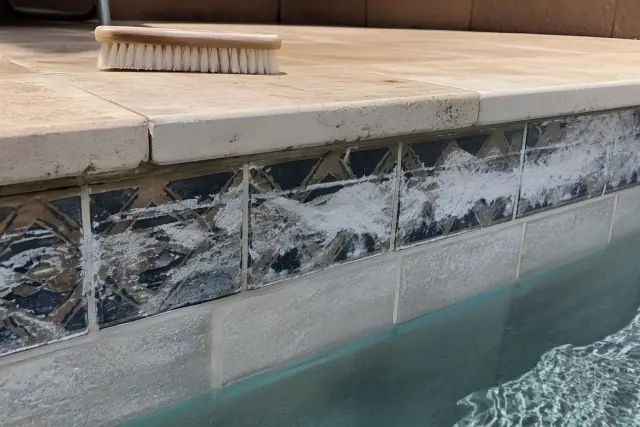
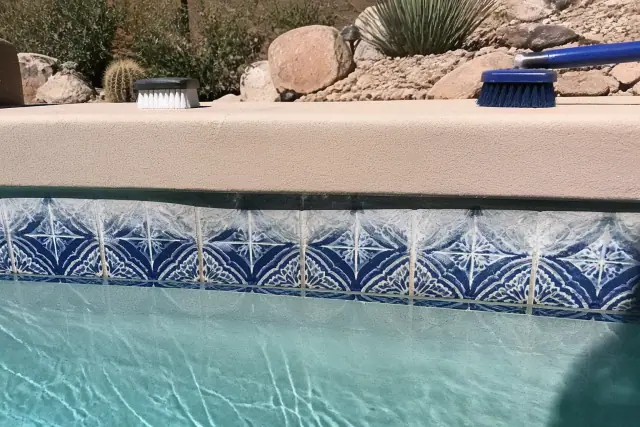
Calcium scale removal on pool tiles in Phoenix, AZ, showing scraped mineral residue and a cleaning brush on the coping.

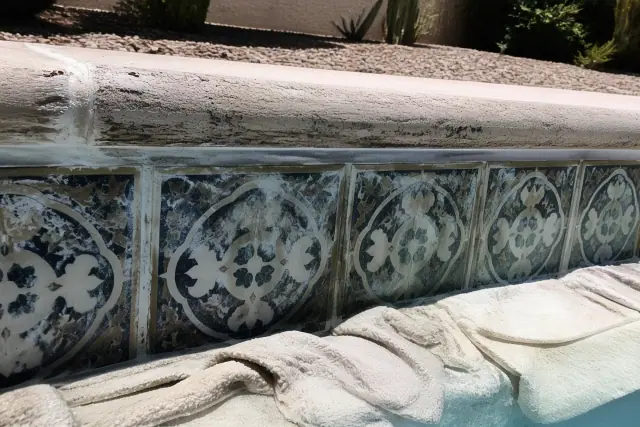
We first distinguish rough white calcium carbonate from gray-to-black calcium silicate. Carbonate may respond to a diluted muriatic acid wipe with careful pumice work, while tightly bonded silicate generally calls for an extended bead-blasting pass because acid alone will not break its bond.

Request Estimate

Low-Pressure Bead Blasting

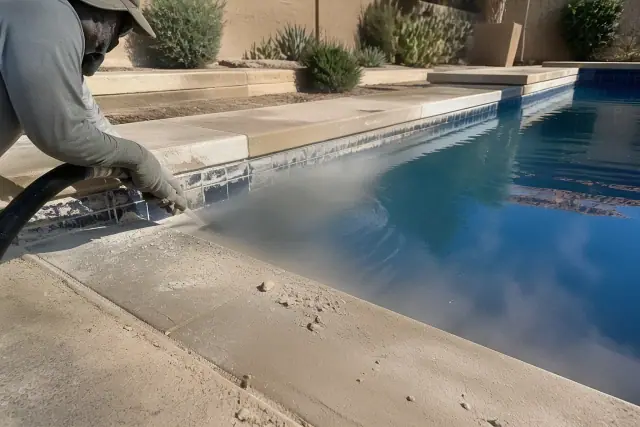
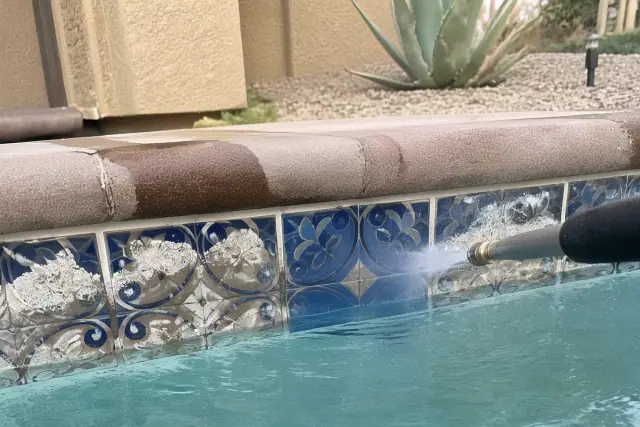
Low-pressure bead blasting process cleaning pool tile in a residential backyard in Phoenix, AZ.

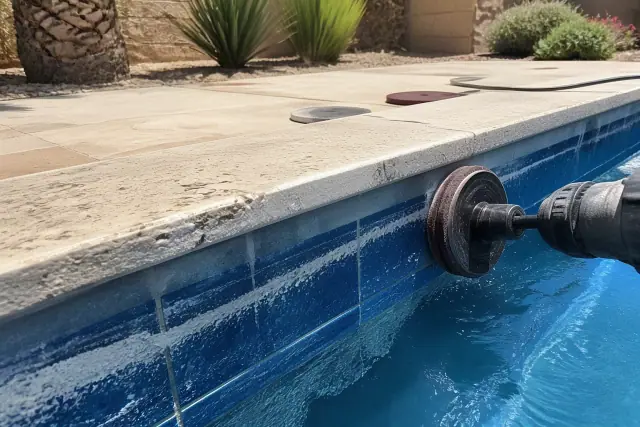
Fine glass or ceramic media removes calcium and biofilm from the tile face at pressure calibrated to the surface. Separate media cartridges and adjustable settings help protect glazed porcelain, glass tile, ceramic, and natural stone from pitting or permanent dulling.

Request Estimate

Pool Tile Restoration

Contractor cleaning pool tiles with abrasive pads in a residential backyard in Phoenix, AZ.

Full restoration addresses the waterline band along with scale around steps, spillways, corners, and raised bond beams. Tile faces are cleaned section by section, porous grout receives a secondary pass, and chipped or loose tile is identified for separate repair rather than being blasted in place.

Request Estimate

Waterline Stain Cleaning

Cleaning mineral deposits from pool waterline tiles at a residential property in Phoenix, AZ.

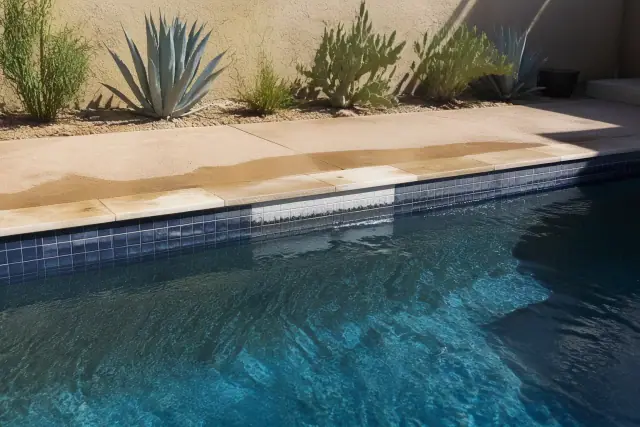
Waterline staining often combines mineral scale with sunscreen and body oils. An enzyme-based degreaser breaks down the organic layer first, allowing pumice work or bead blasting to reach the calcium underneath instead of leaving a hazy residue after scrubbing.

Request Estimate

Pool Acid Washing

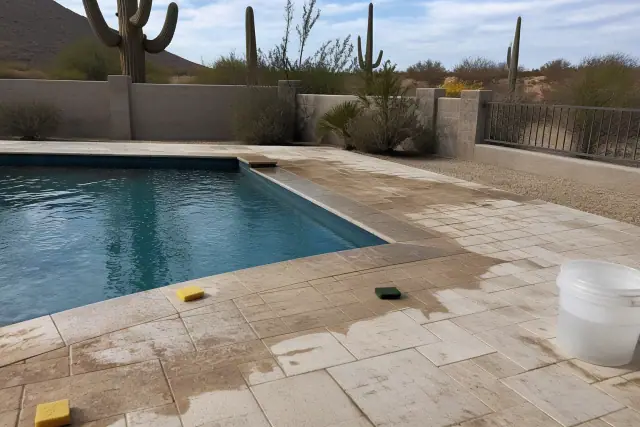
Acid washing pool tiles on a deck with a bucket and sponges in front of a desert landscape in Phoenix, AZ.

An acid wash treats a heavily stained or rough plaster or pebble shell, not just the waterline tile. The pool is drained, a diluted muriatic acid solution strips a very thin surface layer, the acid is neutralized, and the refill is rebalanced; because each wash removes plaster, it is generally not recommended more than once every few years.

Request Estimate

Weekly Pool Cleaning and Chemical Service

Close-up of mineral deposits being cleaned from pool tiles in a Phoenix, AZ backyard with desert landscaping.

Weekly service covers skimming, wall and waterline brushing, vacuuming, basket emptying, chemistry balancing, equipment checks, and filter cleaning on a schedule matched to cartridge, DE, or sand filters. Skipping service for six to eight weeks during a Phoenix summer can be enough for light calcium film to bond. Typical Phoenix-market pricing runs $100 to $150 a month for chemical-only service and $150 to $250 a month for full cleaning with chemicals; annual maintenance averages $900 to $3,000, while a neglected pool that needs green-pool cleanup, acid washing, and tile restoration together can reach $800 to $2,000 in one visit.

Request Estimate
Tile Cleaning Methods

Pool Tile Cleaning Methods

No single tool fits every deposit or tile surface. The practical options range from controlled hand cleaning for light film to calibrated blasting for bonded scale, with spot acid treatment and organic-residue removal used only where the assessment supports them.

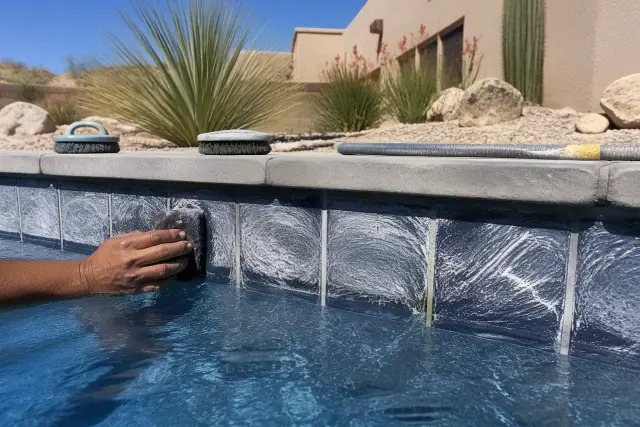
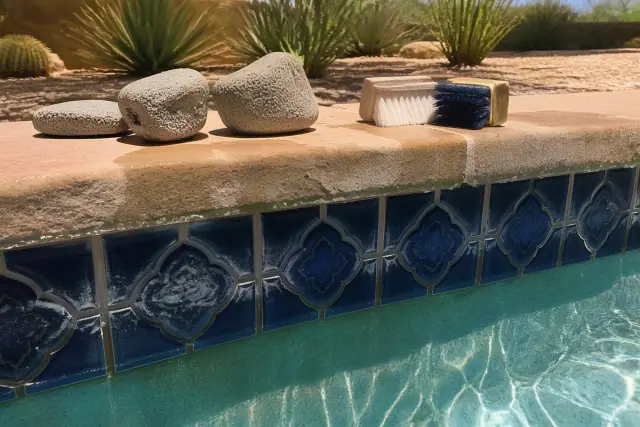
Pumice stones and scrubbers cleaning mineral deposits from pool tiles in a Phoenix, AZ backyard.

Pumice and Nonmetallic Hand Cleaning

Light mineral haze and accessible grout lines may respond to careful hand cleaning. The tool must be compatible with the tile so a cosmetic film does not become permanent surface damage.

  • Pool-tile-rated pumice stones
  • Nonmetallic nylon scrub pads
  • Controlled work along grout lines
  • Best suited to light mineral film
  • No steel wool or generic coarse abrasives
Request Estimate
Bead blasting equipment cleaning calcium buildup from ceramic pool tiles in Phoenix, AZ.

Glass or Ceramic Media Bead Blasting

Low-pressure bead blasting provides even mechanical removal when calcium has bonded beyond a light haze. Media and pressure are chosen for the tile material rather than reused unchanged from pool to pool.

  • Fine glass or ceramic blasting media
  • Adjustable pressure calibrated by tile type
  • Effective on moderate-to-heavy scale
  • Mechanical removal for bonded silicate
  • Surface-specific cartridges for glass, ceramic, and stone
Request Estimate
Rotary pumice and diamond pads cleaning pool tile at a residential backyard in Phoenix, AZ.

Rotary Pumice and Diamond Pads

Rotary tools can remove lighter buildup efficiently when their pad and speed suit the tile hardness. They are selected as a controlled restoration option, not as a universal substitute for assessment or bead blasting.

  • Diamond or pumice pads matched to hardness
  • Controlled passes on lighter buildup
  • Useful where full blasting is unnecessary
  • Pad choice adjusted for each tile finish
  • Care taken to prevent finish-dulling microscratches
Request Estimate
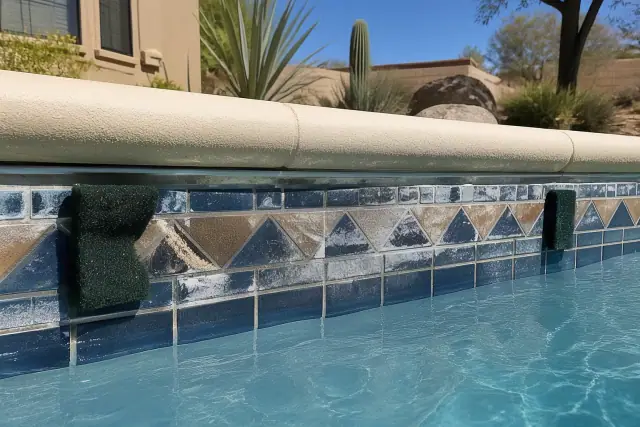
Cleaned calcium spot on swimming pool waterline tiles at a residential backyard in Phoenix, AZ.

Buffered Acid Spot Treatment

A diluted, pH-buffered acid solution can support hand removal of stubborn carbonate deposits in selected areas. It is handled as a controlled spot treatment because silicate scale requires mechanical removal and careless acid use can etch pool surfaces.

  • Diluted muriatic acid used only where appropriate
  • Supports carbonate-scale removal
  • Combined with controlled pumice work
  • Not relied on for calcium silicate
  • Neutralization protects the refill and equipment
Request Estimate
Technician performing enzyme degreasing and algae treatment on pool waterline tiles in Phoenix, AZ.

Enzyme Degreasing and Algae Treatment

Organic waterline residue needs a different first step from mineral scale. Enzyme degreasing clears oils so mechanical cleaning can reach the calcium, while dark algae staining may also call for chlorine shock treatment before chemistry is stabilized.

  • Breaks down sunscreen and body-oil film
  • Exposes the mineral layer beneath residue
  • Pairs with pumice or bead blasting as needed
  • Addresses spores after mechanical algae removal
  • Supports a free-chlorine target of 1 to 3 ppm
Request Estimate
Finding Your Right Fit

Choosing the Right Tile Cleaning Approach

The best approach follows four observations: whether the deposit is carbonate or silicate, how thick it is, what the tile is made from, and whether the grout is sound. Light film may justify hand work, bonded scale may require calibrated blasting, organic residue needs degreasing first, and damaged grout or loose tile should be isolated before cleaning begins.

Surface-Specific Method Selection

We inspect the calcium, staining, grout, and tile hardness before choosing a tool. Glass tile, glazed ceramic, natural stone, plaster, pebble, and fiberglass each receive a compatible method instead of the same abrasive and pressure.

Bonded and Insured Pool Service

Phoenix Expert Pool Service is bonded and carries general liability coverage appropriate to tile cleaning, acid washing, pool repair, equipment repair, and pump replacement. That protection matters most when work involves draining a pool, handling acid, or cleaning around already weakened tile and grout.

Pool Chemistry and Tile Training

Our technicians carry Certified Pool Operator training and stay current on Pool & Hot Tub Alliance standards. That chemistry background supports the same careful work as the physical restoration: identify the scale, protect the surface, and rebalance the water so fresh calcium does not immediately redeposit.

What Sets Us Apart

Why Choose Us for Pool Tile Cleaning?

We combine tile-material assessment, water-chemistry training, calibrated equipment, bonding, and liability coverage in one restoration process. Grout is checked before blasting, loose tile is flagged rather than forced through cleaning, and the finished waterline is reviewed with you for consistent color, texture, and intact grout.

Get a Free Estimate

Rapid Mineral Concentration

Water delivered through the Salt River Project and Central Arizona Project brings dissolved minerals that remain when pool water evaporates. A pool losing a quarter inch of water a day continuously concentrates those minerals at the surface, and calcium hardness above 400 ppm can produce visible scale in eight to twelve weeks without regular balancing.

Silicate Scale That Resists Acid

Phoenix has well over 100 days a year above 100 degrees, giving evaporation more opportunity to concentrate minerals at the tile line. Gray-to-black calcium silicate bonds tightly to glaze and grout, often signals extended pH or alkalinity drift, and needs mechanical bead blasting because acid alone does not release it.

Sunscreen and Body-Oil Film

The waterline is where evaporation, splashing, sunscreen, and body oils meet in a narrow band. Removing only the mineral layer can leave a dull haze, so an enzyme-based degreaser is used first when organic residue is covering the calcium beneath it.

Algae Anchored in Rough Scale

Rough calcium gives algae protected anchoring points that ordinary brushing may miss. Dark green or black staining can require mechanical scale removal followed by chlorine shock treatment, with a phosphate remover considered where fill-water phosphate levels run high.

Separating Grout and Loose Tile

Untreated scale can trap debris, degrade grout, and allow water intrusion behind tile. Older Phoenix backyard pools built in the 1980s and 90s can show decades of buildup alongside separating grout, so compromised areas are flagged and cleaning stops where blasting could knock tile loose.

Permanent Etching and Microscratches

Metal tools, steel wool, coarse pads, uncontrolled pressure, and mismatched blasting media can permanently scratch glass or glazed porcelain tile. Improper acid use can also etch plaster unevenly, turning removable staining into surface damage that cleaning cannot reverse.

How It Works

Our Pool Tile Cleaning Process

The restoration sequence protects the tile before it removes scale: inspect the waterline, identify the deposit, prepare the pool and deck, match the tool to the surface, clean in controlled sections, and finish with water-chemistry balancing and a walkthrough.

01.

Inspect Tile and Grout

We walk the full tile line and note scale thickness, stain type, tile material, grout integrity, and chipped or loose pieces. Areas with compromised grout are isolated before any mechanical cleaning begins.

02.

Identify Carbonate or Silicate

We test whether the deposit is calcium carbonate or calcium silicate and assess any organic film covering it. This determines whether the work calls for pumice, buffered acid support, enzyme degreasing, or bead blasting.

03.

Lower Water and Protect the Deck

For standard waterline cleaning, the pool level typically drops three to six inches below the tile band. The surrounding deck and coping are protected before media, hand tools, or cleaning solutions are brought to the waterline.

04.

Match the Method to the Surface

The tile hardness, scale type, buildup thickness, and grout condition set the cleaning plan. Pressure, media, pad grit, and acid dilution are chosen for that pool rather than guessed from a generic setting.

05.

Clean Tile, Grout, and Tight Areas

We work section by section across the tile face, then give porous grout a secondary pass. Acid-safe hand tools reach corners, spillways, steps, and raised bond beams where blasting equipment cannot cleanly follow the contour.

06.

Refill, Rebalance, and Review

After cleaning, we restore the water level, rebalance pH, alkalinity, and calcium hardness, and inspect the finish for consistent color and texture. The completed waterline is reviewed with you, and chemical handling or disposal follows Arizona Department of Environmental Quality guidance when acid work is involved.

Restore Your Waterline

Schedule a Pool Tile Cleaning Estimate

If your Phoenix pool tile looks chalky, gray, crusted, oily, or algae-stained, request a free on-site estimate. We will inspect the material and buildup, explain the appropriate cleaning method, and quote the work before restoration begins.

Pool Tile Cleaning Help

Pool Tile Cleaning FAQs

These answers cover cleaning methods, timing, cost, prevention, pool chemistry, surface protection, and service throughout the Phoenix area.

Call Our Pool Experts

The best method depends on the deposit and tile material. Light film may respond to a tile-rated pumice stone or nonmetallic pad, while moderate-to-heavy scale generally needs low-pressure bead blasting with fine glass or ceramic media; household vinegar or citric acid may help only with very light film and will not remove bonded silicate.

Most Phoenix pools benefit from a professional inspection and light cleaning every three to six months. Pools on consistent maintenance may need full calcium removal roughly once a year, while pools without weekly service or with elevated calcium hardness may need attention more frequently.

Phoenix Expert Pool Service provides professional pool tile cleaning in Scottsdale as part of its Salt River Valley service area, along with Phoenix, Tempe, Mesa, Chandler, and Glendale. Free estimates are available for Scottsdale properties, and tile cleaning can be coordinated with routine pool maintenance.

Professional tile cleaning in the Phoenix market runs roughly $1.75 to $2.15 per linear foot, and a standard 40 to 60 linear foot residential waterline usually falls between $150 and $400. Calcium removal generally ranges from $150 to $500 depending on thickness, tile length, steps, spillways, and draining needs; heavy silicate scale or larger pools can reach $500 or more. A firm quote follows an in-person inspection because tile material and scale type affect the method.

Common mistakes include using metal tools, steel wool, coarse abrasives, or the wrong blasting media on glass or glazed porcelain. Other errors include using acid alone on silicate, scrubbing through weakened grout, and skipping the pH and alkalinity check that helps prevent rapid redeposit.

For a light film, use a pumice stone specifically rated for pool tile or a nonmetallic nylon pad that is compatible with the surface. Moderate or heavy calcium is better handled with low-pressure bead blasting and fine media matched to the tile, while generic household abrasives and steel wool should be avoided.

Weekly maintenance should include skimming, brushing the walls and waterline, vacuuming, emptying skimmer and pump baskets, and testing chlorine, pH, alkalinity, and calcium hardness. The pump, filter, and heater should receive a visual check, and cartridge, DE, or sand filters should be cleaned on an appropriate rotating schedule.

Calcium carbonate usually appears as rough white scale and may respond to a diluted acid wipe combined with pumice. Calcium silicate is typically gray to black, bonds more tightly to tile and grout, and generally requires mechanical bead blasting because acid alone will not break the bond.

Most residential jobs take two to four hours, depending on the waterline length, scale thickness, tile material, and any steps or spillways included. Standard waterline cleaning usually requires only a partial water-level drop, so most residential pools remain swimmable the same day.

Tile cleaning treats the waterline band, while an acid wash treats a heavily stained, mottled, or rough plaster or pebble shell after brushing and chemical treatment are no longer enough. The pool must be fully drained, the acid neutralized, and the refill rebalanced, so acid washing is reserved for severe surface conditions rather than routine tile film.

Keeping calcium hardness between 200 and 400 ppm and total alkalinity between 80 and 120 ppm helps limit scale formation. Consistent chemical service, a scale inhibitor for pools that historically scale quickly, and periodic waterline wiping can catch buildup before it becomes a crusted band.

Larger community and HOA pools, including properties in Ahwatukee and Anthem, may need extended sessions because surface area and calcium thickness increase the work. Public and semi-public pools also require attention to the regulatory context set by Maricopa County Environmental Services, and larger projects may have a lower per-foot rate even when their total cost is higher.

After cleaning, the water level is restored, pH, alkalinity, and calcium hardness are rebalanced, and the waterline is checked for consistent color, texture, and intact grout. Monthly maintenance plans can include follow-up checks, with quarterly tile inspections helping catch returning film while it is still light work.